

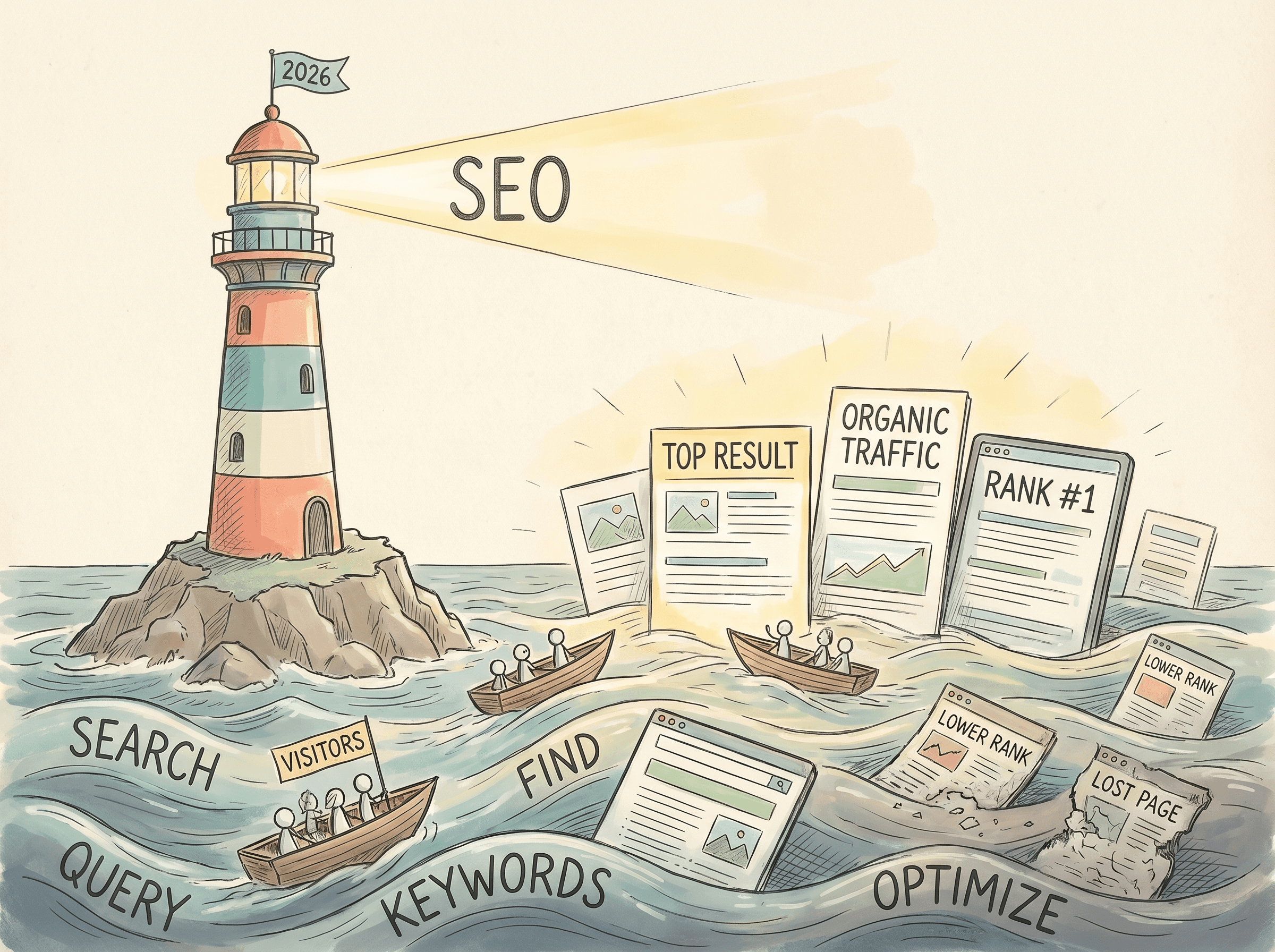
Search engine optimisation in 2026 is a different discipline from the one practised a few years ago. Google answers a large share of queries directly at the top of the results, ChatGPT has become a research channel in its own right, and mediocre content no longer earns a click. This guide covers what SEO is actually made of, where a business should start, and how to tell whether it is working.
What SEO is — and why it is worth more now, not less
Search engine optimisation means developing a website so it is found in search engines and AI search for the queries your customers actually use. When someone searches "employment solicitor Manchester" or "how to set up an online shop", they are not browsing. They have stated a need. SEO puts your business in front of that moment.
Two things make organic visibility unusually valuable:
- Intent. The searcher describes their own problem. That is why organic visitors typically convert better than traffic from social or display advertising.
- Compounding. Advertising is rented: visibility stops when payment stops. A well-built page keeps bringing visitors month after month with no cost per click, and the results accumulate year on year.
The common objection — that AI answers are killing organic traffic — is half right. Informational queries that used to earn a click now often end in a summary. But being the source that summary cites is worth more than being the fourth blue link ever was, and commercial queries still send people to websites. The work has shifted, not disappeared.
The four pillars of SEO in 2026
1. Technical foundations
Before anything else can work, search engines have to be able to reach, render and understand your pages. That means crawlability and indexing, page speed, Core Web Vitals, mobile usability, sensible redirects and structured data.
Google's own thresholds for a "good" Core Web Vitals score are an LCP of 2.5 seconds or less, an INP of 200 milliseconds or less, and a CLS of 0.1 or less (web.dev). These are not arbitrary targets; they are also the point at which conversion rates stop being damaged by the page itself.
This is the cheapest work on the list, and the work that caps everything else. See technical SEO.
2. Content
Content is where the ranking is actually earned. That means pages built around what buyers search for, answered at the depth the query deserves, by someone who knows the subject.
The bar has risen sharply. A generic 800-word article restating what already ranks will not displace anything, because it adds nothing. What works is first-hand specificity: your data, your cases, your method, stated plainly. See content production.
3. Authority
Search engines use external signals to judge whether a site deserves trust. Links from credible sites remain the strongest of these, alongside brand mentions, citations and consistent presence in the places your industry gathers.
Authority cannot be bought safely. Link schemes are detectable and the downside is severe. What works is being worth citing — and then making sure the people who might cite you know you exist.
4. AI visibility (GEO)
The newest pillar. When a search ends in a generated answer, the question stops being "where do we rank" and becomes "are we the source being quoted".
That depends on the same technical foundations — AI crawlers need access and content that renders without heavy JavaScript — plus content structured so a machine can lift a claim and attribute it confidently. See generative engine optimisation.
Where to start: the order matters
Most businesses start in the wrong place. They commission a blog before anyone has checked whether Google can index the site, or they buy links before there is anything worth linking to. The money is not wasted exactly, but it is spent at a fraction of its effect.
The sequence that works:
- Fix the technical barriers. Cheapest, fastest, and it caps everything else. Until Google can crawl and render your pages, nothing above this line matters.
- Get the commercial pages right. The pages where people actually buy. These are usually neglected in favour of blog content, which is backwards: they carry the highest intent and the shortest path to revenue.
- Then build content. Guides and articles that answer the questions surrounding those commercial pages, linked to them deliberately.
- Then build authority. Once there is something on the site worth citing.
What does SEO cost?
Honest answer: it depends on the size of the site, the competitiveness of the market and how much is already broken. In the UK, retained SEO for a small business typically starts in the hundreds of pounds a month; mid-market programmes commonly run in the low thousands; and enterprise work with large content and development requirements runs considerably higher.
What matters more than the number is what it buys. A £1,500-a-month retainer that funds two days of senior work is a different product from one that funds a junior producing four blog posts. Ask what hours you are buying, from whom, and what they will be spent on. We cover this in detail in what SEO costs in 2026.
In-house or with a partner?
In-house makes sense when search is central enough to your business to justify a permanent, senior hire — and when you can keep that person busy and current. The risk is a single point of failure who is expected to cover technical work, content and outreach simultaneously.
A partner makes sense when you need several specialisms at once and cannot justify hiring all of them. The risk is buying reports instead of work. The way to tell the difference before signing is to ask what would be done in the first ninety days and why in that order. A good answer is specific to your site. A bad one is a list of deliverables.
Frequently asked questions
How long does SEO take to work?
Is a blog enough on its own?
How does AI search change SEO?
Can anyone guarantee a number one ranking?
Where is your site leaking?
The website audit checks your technical setup, keywords, competitors and AI visibility — and puts a number on the revenue you are leaving on the table each month.