

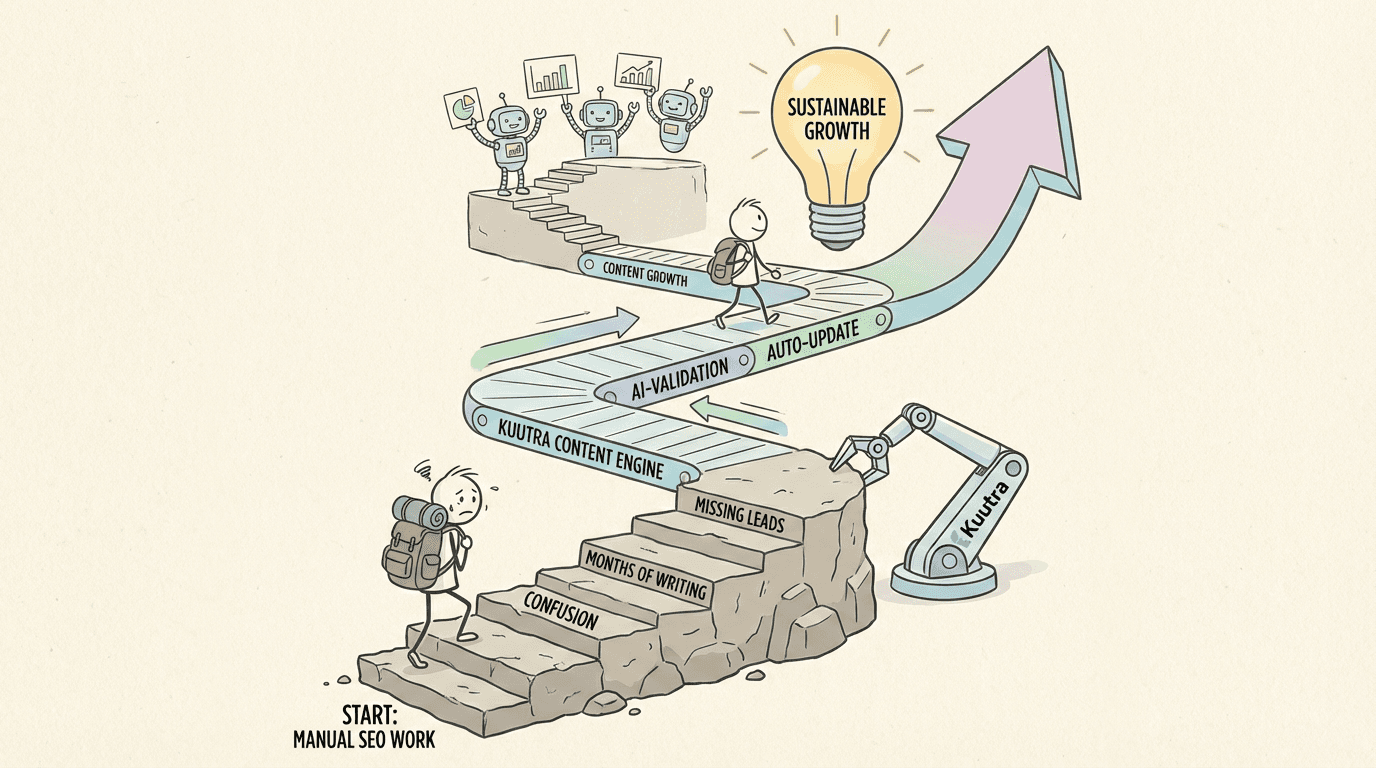
"Organic growth engine" sounds like the kind of phrase invented to make ordinary work sound proprietary. It is worth defining precisely, because the distinction it describes is real.
An engine is not a list of SEO activities. It is a system with three properties: defined inputs, a repeatable production process, and a feedback loop that decides what to do next. The difference between having one and not is whether output continues when nobody is chasing it.
Why this distinction matters
Most organic programmes are a sequence of projects. Someone commissions an audit, some fixes get made, some articles get written, attention moves elsewhere, and eighteen months later the site is back where it started.
A system behaves differently. It knows what it is targeting and why, it produces on a rhythm, and it measures what each output earned — so next month's decisions are informed by last month's results rather than by whoever spoke loudest.
How it differs from traditional SEO
| Project-based SEO | Growth engine | |
|---|---|---|
| Targeting | Decided per project | Standing cluster map, reprioritised monthly |
| Production | Commissioned ad hoc | Defined process, predictable rhythm |
| Measurement | Reported | Fed back into next month's priorities |
| Output when unattended | Stops | Continues |
| Cost per output | Flat or rising | Falls as the process matures |
The components
A technical foundation that stays fixed. Not a one-off audit but continuous monitoring, so regressions get caught before they cost three months of visibility. See technical SEO.
A standing map of clusters. The questions you intend to own, ranked by commercial value, kept current. This is what turns "what should we write about" from a monthly debate into a lookup. See keyword research.
A production process. A defined path from brief to published, with research, expert review and internal linking built in rather than remembered.
Distribution. Publishing is not promotion. The engine includes how each piece reaches the people who might cite or share it.
Measurement that closes the loop. Per-cluster visibility, per-page conversions, AI citations. Not for reporting — for deciding.
Authority building. The external signals that make the whole thing credible, run continuously rather than in campaigns.
Building one
The sequence matters more than the speed:
- Measure the baseline. What organic currently earns, and what the gap is worth. If the gap is small, stop here.
- Clear the technical barriers. Cheapest work, and it caps everything above it.
- Build the cluster map. Decide the questions, rank them by value.
- Rebuild the commercial pages. Highest intent, shortest path to revenue, usually the most neglected.
- Start the production rhythm. One cluster at a time, in priority order.
- Close the loop. Monthly: what moved, what did not, what gets prioritised next.
Step six is what makes it an engine. Without it you have a content calendar with extra steps.
Where automation fits
Automation lowers the running cost of the mechanical parts — research, monitoring, first drafts, formatting, translation. It is what makes an engine affordable to run at scale rather than what makes it work.
The judgement stays human: what to target, what claim is defensible, what your business knows that competitors do not. See SEO automation.
Where it goes wrong
- Skipping the baseline. Building without knowing what the opportunity is worth.
- Building production before targeting. A fast process pointed at the wrong questions produces expensive nothing.
- Never closing the loop. The most common failure, and the one that turns a system back into a calendar.
- Stopping at month four. The investment is front-loaded and the return is not. Month twelve benefits from everything published before it.
Frequently asked questions
How is this different from just doing SEO?
How long does it take to build?
Does it require automation?
What size of business does this suit?
See what your engine would be worth
The audit sizes the organic demand you are not currently capturing, in pounds per month.